I have a big list of projects that I have started that I haven't even written about, thinking that I would do the work in season and write about it in the winter when I had nothing to do. But to my surprise, I continue to be busy doing other projects that really are best suited to winter.
Part of what I am doing is researching projects and my list is fast growing. My difficulty is that I am really busy simply feeding the kids and doing laundry let alone get big projects going plus the kids are not at the age where they can do a lot of heavy work.
As if the universe was listening to my wishing, along came a local permaculturist who was looking for land access. He wanted to have access to land to run courses for local urbanites to learn how to convert their yard to a permaculture producing property. Since then another permaculturist has asked to run a course on our property for his courses.
They both proposed that they offer a class on our property and that we participate in the class by seeing the conclusion or even attending the lectures.
Our first phase is to have students come and look at the property to do planning. We come up with a list of what we would like built or planted and they figure out the best placement. Students are invited to share the plans with us when they are done and we attend the presentation.
I have an ever expanding list of projects but my first will focus on year-round food production, water catchment and maybe even housing. I would really like to have some WWOOFers who could live here, but in their own space. http://www.wwoof.ca/
Years ago I was researching how to build a tipi and wanted to build one for my yard. If we had some permaculturists here, I would pay for all the materials and the students would learn how to build it. I don't know any First Nations or Metis Permaculturists, so I may have to design a course myself.
So consider inviting a local permaculturist to run courses on your land to get more people learning about permaculture principles. I don't think it matters if your property is a small urban space as we will need to design for small spaces too.
http://www.bigskypermaculture.ca/
http://www.vergepermaculture.ca/
Check out these Calgary Permaculturists who are running courses. Check your community, you might have brilliant people in your neighbourhood.
Wednesday, February 2, 2011


Friday, December 17, 2010
Vertical Veggie Farms New Website
 |
| Dec. 17, 2010 Wax Bush Bean Flower Seeds of Change |
verticalveggiefarms.com
You can find out why Vertical Veggie Farms are part of the leading edge of solutions for Urban Agriculture and find out why Vertical Gardening is gaining popularity.
It is snowing light fluffy snow today, Dec. 17, 2010, and to my delight, inside on my Vertical Veggie Farm, my bean plants started flowering. It won't be long before I have some nice bush beans to feed my family. My lettuce is growing really well and I am struggling with the urge to let the leaves grow bigger or to have some baby green salads. Maybe I will wait for Christmas dinner to serve the first salad, then have turkey sandwiches with fresh VVF lettuce.
Thursday, December 16, 2010
Gifts for Winter: Frankincense and Myrrh
Today it is snowing a light dry powdery snow that skiers wish for and children love to brush their bulky knit mittens through; it is a beautiful winter wonderland outside. I am inside struggling with a chest cold an in an effort to make me feel better, I put some frankincense and myrrh in my vaporizer. The fragrance from these resins fills the air with an ancient spicy warmth.
The gum from these small trees or shrubs were widely used in Egypt, India, China, and North East Africa near the Red Sea Region and considered to be as valuable as gold. Frankincense and Myrrh is well known as two of the three gifts of the Magi, gifts from the Three Wise Men to the infant Jesus. The tree gums were made into an essential oil by mixing with oil or water. These plants from the Cradle of Civilization have come with us as treatments for ailments. I don't know if anyone knows how essential oils in aromatherapy works as a treatment but they have been used for millenniums.
I didn't really think about possible uses of frankincense and myrrh until I started using essential oils. Myrrh has many uses as a therapeutic essential oil, commonly used for menstrual problems, haemorrhoids, as well as for amenorrhea, leucorrhea, pruritis and thrush. Frankincense is associated as a treatment for cystitis, dysmenorrhea, leucorrhea and metrorrhagia. When I first read that they were treated for women's genito-urinary systems, I thought, maybe the gifts weren't for baby Jesus but for postnatal Mary.
Of course these wonder gums have many other uses, one of my favourite is that they work on the respiratory system, helping to calm colds and the flu. Now every December, I bring out the frankincense and myrrh and put it in the vaporizer to not only ward off or to treat illness, but to also fill the air with the rich, ancient smells of the Middle East. I associate the smell with a connection to the rich history of mankind's ancient wisdom. It comforts me to have the same fragrance in the air that women like Cleopatra might have had. It quite simply makes me feel connected to women throughout history and I like that.
Well it wasn't until I started writing this out that I have such a strong link between scent and meaning, but there it is. I know a lot of women have strong pulls to scent; look in any product marketed to women and it will be heavily scented. Given that many artificial scents are not healthy and are sometimes even damaging, I hope that you might recognize your pull to scent and become a conscious and safe consumer of cosmetic and medical products.
Myrrh should not be used during pregnancy; avoid use around pregnant women.
This information is not to be taken as medical advice; readers must take responsibility for their own healing, consulting a qualified practitioner when needing medical attention.
Sources:
Lacroix, Nitya, The Scented Touch, Sebastian Kelly, Oxford UK, 1994.
Lawless, Julia, The Illustrated Encyclopedia of Essential Oils, Element Books, Inc. Rockport, MA, 1995.
 |
| Frankincense (left), Myrrh (right), combined in vaporizer, just needs a bit of water; can be reused until gone |
The gum from these small trees or shrubs were widely used in Egypt, India, China, and North East Africa near the Red Sea Region and considered to be as valuable as gold. Frankincense and Myrrh is well known as two of the three gifts of the Magi, gifts from the Three Wise Men to the infant Jesus. The tree gums were made into an essential oil by mixing with oil or water. These plants from the Cradle of Civilization have come with us as treatments for ailments. I don't know if anyone knows how essential oils in aromatherapy works as a treatment but they have been used for millenniums.
I didn't really think about possible uses of frankincense and myrrh until I started using essential oils. Myrrh has many uses as a therapeutic essential oil, commonly used for menstrual problems, haemorrhoids, as well as for amenorrhea, leucorrhea, pruritis and thrush. Frankincense is associated as a treatment for cystitis, dysmenorrhea, leucorrhea and metrorrhagia. When I first read that they were treated for women's genito-urinary systems, I thought, maybe the gifts weren't for baby Jesus but for postnatal Mary.
Of course these wonder gums have many other uses, one of my favourite is that they work on the respiratory system, helping to calm colds and the flu. Now every December, I bring out the frankincense and myrrh and put it in the vaporizer to not only ward off or to treat illness, but to also fill the air with the rich, ancient smells of the Middle East. I associate the smell with a connection to the rich history of mankind's ancient wisdom. It comforts me to have the same fragrance in the air that women like Cleopatra might have had. It quite simply makes me feel connected to women throughout history and I like that.
 |
| a clay vaporizer, heated with a small votive candle |
Myrrh should not be used during pregnancy; avoid use around pregnant women.
This information is not to be taken as medical advice; readers must take responsibility for their own healing, consulting a qualified practitioner when needing medical attention.
Sources:
Lacroix, Nitya, The Scented Touch, Sebastian Kelly, Oxford UK, 1994.
Lawless, Julia, The Illustrated Encyclopedia of Essential Oils, Element Books, Inc. Rockport, MA, 1995.
Wednesday, December 1, 2010
Beeswax Candles
 |
| Beeswax Candles & leftover puck of wax Wax courtesy of Jerremie Clyde Photo Credit: Ursula de Vries |
Those of us who want to be more environmental can reduce electricity use by using candles. While participating in Earth Hour in March of 2010, I clumsily spilt hot paraffin wax all over my arm and realized that not only was I breathing in petroleum byproducts, but I was getting skin contact too. I decided then to get rid of all the paraffin and artificially scented candles and replace them with beeswax.
I was planning on getting bees so beeswax was a bonus yield along with nutritious honey and garden pollination. We plan on getting bees in the spring and won't get any beeswax until the following autumn, but I didn't want to wait to start using candles so ordered some moulds and wax from the BeeMaid Honey Online store. http://www.beemaidbeestore.com/
 | ||||
| Beeswax straight from honey extracting with globs of honey on surface Wax Courtesy of Jerremie Clyde Photo Credit: Ursula de Vries
|

I knew that burning beeswax created a lovely light scent of honey in the air, but didn't even think about how fragrant the air would be while melting the beeswax. The entire house was perfumed with a sweet floral aroma that was comforting on a cold November afternoon.
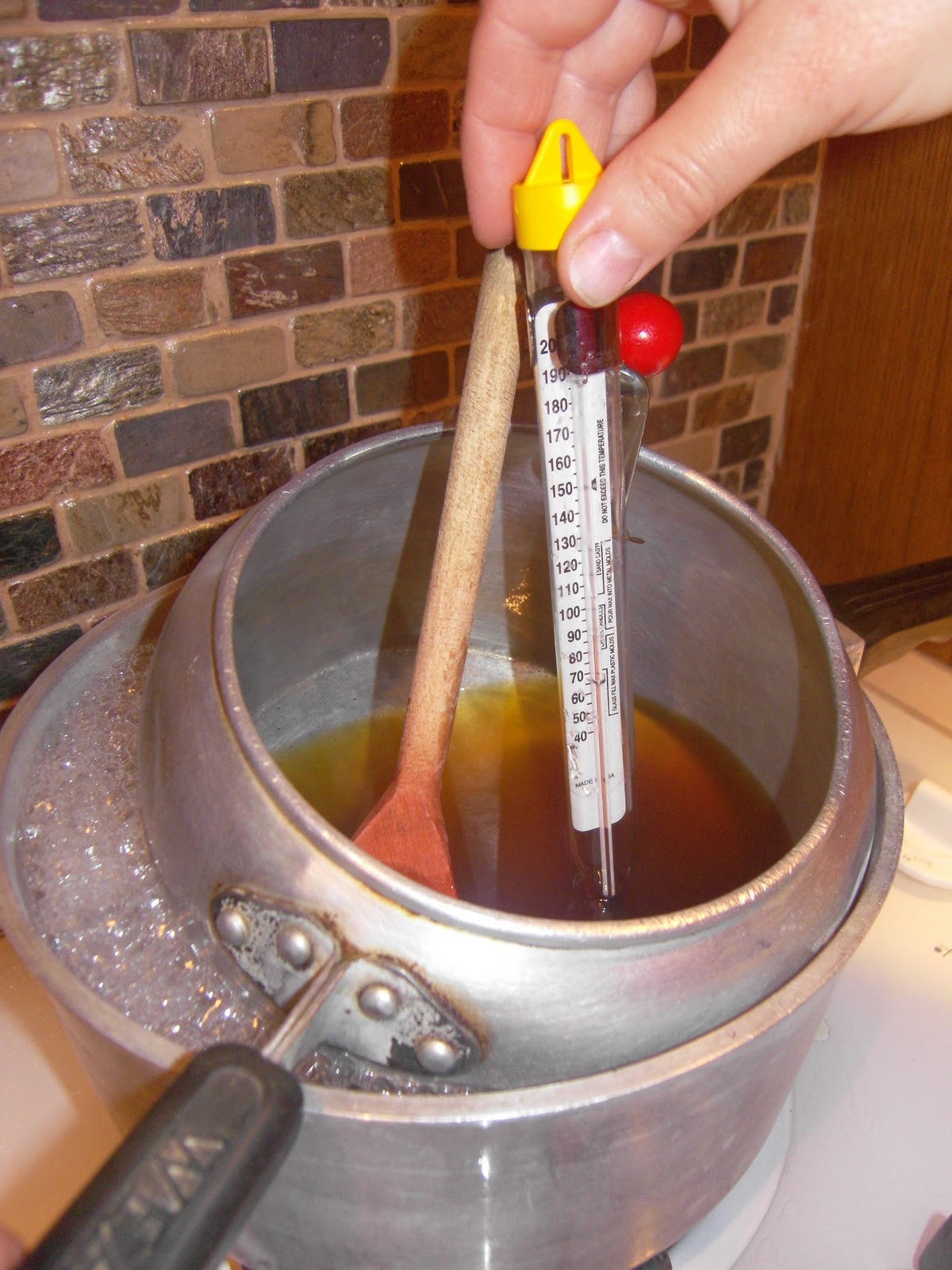
When we started melting the raw wax from my beekeeper friend, (www.urbansunflower.ca) I was worried about bee legs and wings becoming part of the candle and smelling bad as it burned. As we melted the wax, most of the honey and bits of grass and bugs either floated or sunk to the bottom of the pot. We placed a bit of cheesecloth over the metal funnel as we poured the melted wax into the moulds.
I wanted to save the cheesecloth and show it to my kids after because there were bits of pupa, larva and bee parts but the wax clumped everything together and dried cloudy. I saved the ball of cloth, wax and bits for a fire starter. There was a little bit of wax leftover and we kept that for either next time or to use to make lip balm.
The wax in the candles shrunk as it cooled and was easy to pull from the moulds. When we took them out, the candles made from the raw, honey covered wax was just as beautiful as the candles made from the filtered store bought wax.
The process was pretty much an adult activity because of the temperature but the kids were buzzing around curious about this activity.
A friend of ours came over with a box of beeswax sheets and we made candles with the kids. We cut a piece of wick, laid it across one end of the sheet and pointed the hair dryer to soften the wax as the kids rolled up their own candles.
We could have added some essential oils or wax crayon peelings for scent and colour but decided to just do it natural the first time. I bet some frankincense and myrrh would have been lovely for use in the winter to ward off colds and the flu.
 | ||
| Beeswax candle making in silicone muffin mould shown with metal funnel/cheesecloth strainer Photo Credit: Ursula de Vries
|

 |
| Completed Rolled Beeswax Candles Photo Credit: Ursula de Vries |
http://en.wikipedia.org/wiki/Winter_solstice
Thursday, November 11, 2010
Vertical Veggie Farms
Portable Year-Round Indoor Hydroponic System for Home, Office or Institution
Custom Builds available for Schools, Elder-Care Facilities, Hospitals, Businesses, Community Centres, Correctional Centres, etc.
Now you can now grow vegetables year-round for very low cost in your picture window or patio door. Utilize free solar energy and still enjoy your view out your patio window.
I am very pleased to launch the Vertical Veggie Farm. You may now place your order for delivery.
The cost is $340 to purchase.
 As I am a strong believer in sustainability and encouraging local businesses, I offer a discounted price to those willing to pay in Calgary Dollar$; the cost is $300 (of which 25% or $75 may be paid in Calgary Dollar$).
Launch of the VVF at Hillhurst Sunnyside Calgary Dollar$ Potluck, November 10th, 2010.
This is the mini version. The full version has 4 rows of planter spaces with a fifth row for reservoirs.
Delivery within Calgary city limits available for $15.
The Vertical Veggie Farm is a moveable hydroponic system that is oriented vertically to take up little floor space. The full system measures 62" high, 20" deep, and 45" wide.
The system includes: moveable stand, wire suspension columns, 15 plant spaces and 5 solution reservoirs (made from recycled bottles), 4 daylight 23W CLF bulbs (100W equivalent), suspended lighting system, timer, 15 hydroponic starter cubes, hydroponic growing fill (food grade plastic made from recycled bottles), plant cups, organic hydroponic solution, pH tester kit, weed block fabric, and heritage seeds: beans, lettuce, chard and kale. You will also receive instructions for: assembly of the unit, seeding instructions, hydroponics basics and troubleshooting your growing vegetables.
Kit comes fully prepared, simple assembly tools provided.
Takes little electricity: the CLF bulbs are the only electrical component with each bulb only requiring 23W to deliver the equivalent of 100W per bulb. The lighting only needs to be turned on during the short winter days or when you want to boost the growth of your plants.
Takes little time to maintain: Change the hydroponic solution each week. Occasionally clean the plant reservoir holders as needed. Harvest continually.
Harvestable plants will be ready between 40 - 60 days depending on intensity of growing and plant species.
It is an exciting time for hydroponics with the introduction of Compact Light Fluorescents. Traditionally, hydroponics operations have required expensive to purchase and operate lighting ballasts. Systems took up a lot of floor space so the hobby or home hydroponic user had to set aside a large space or even room to grow. Because the areas were so big, they had to be out of the way, requiring extensive ventilation and heating. The high cost of operating these systems meant that high profit/yields were the priority unless it was for a commercial outdoor greenhouse.
Now the average apartment dweller without land access can have fresh vegetables using free sunshine, regular room temperatures with no ventilation worries. Low income households can set up a system and have access to continuous harvests of low cost, fresh, tasty, and nutritious vegetables with minimal work.
Ursula de Vries
Founder, Designer and Builder
verticalveggiefarms@gmail.com
403-542-4321
http://tinyurl.com/facebookvvf
verticalveggiefarms.blogspot.com
- Garden in your window
- Grow fresh food even in the middle of winter
- Intense and productive growing material
- Uses recycled materials
- Moves with you
Custom Builds available for Schools, Elder-Care Facilities, Hospitals, Businesses, Community Centres, Correctional Centres, etc.
Now you can now grow vegetables year-round for very low cost in your picture window or patio door. Utilize free solar energy and still enjoy your view out your patio window.
I am very pleased to launch the Vertical Veggie Farm. You may now place your order for delivery.
The cost is $340 to purchase.

Launch of the VVF at Hillhurst Sunnyside Calgary Dollar$ Potluck, November 10th, 2010.
This is the mini version. The full version has 4 rows of planter spaces with a fifth row for reservoirs.
Delivery within Calgary city limits available for $15.
The Vertical Veggie Farm is a moveable hydroponic system that is oriented vertically to take up little floor space. The full system measures 62" high, 20" deep, and 45" wide.
The system includes: moveable stand, wire suspension columns, 15 plant spaces and 5 solution reservoirs (made from recycled bottles), 4 daylight 23W CLF bulbs (100W equivalent), suspended lighting system, timer, 15 hydroponic starter cubes, hydroponic growing fill (food grade plastic made from recycled bottles), plant cups, organic hydroponic solution, pH tester kit, weed block fabric, and heritage seeds: beans, lettuce, chard and kale. You will also receive instructions for: assembly of the unit, seeding instructions, hydroponics basics and troubleshooting your growing vegetables.
Kit comes fully prepared, simple assembly tools provided.
Takes little electricity: the CLF bulbs are the only electrical component with each bulb only requiring 23W to deliver the equivalent of 100W per bulb. The lighting only needs to be turned on during the short winter days or when you want to boost the growth of your plants.
Takes little time to maintain: Change the hydroponic solution each week. Occasionally clean the plant reservoir holders as needed. Harvest continually.
Harvestable plants will be ready between 40 - 60 days depending on intensity of growing and plant species.
It is an exciting time for hydroponics with the introduction of Compact Light Fluorescents. Traditionally, hydroponics operations have required expensive to purchase and operate lighting ballasts. Systems took up a lot of floor space so the hobby or home hydroponic user had to set aside a large space or even room to grow. Because the areas were so big, they had to be out of the way, requiring extensive ventilation and heating. The high cost of operating these systems meant that high profit/yields were the priority unless it was for a commercial outdoor greenhouse.
Now the average apartment dweller without land access can have fresh vegetables using free sunshine, regular room temperatures with no ventilation worries. Low income households can set up a system and have access to continuous harvests of low cost, fresh, tasty, and nutritious vegetables with minimal work.
Ursula de Vries
Founder, Designer and Builder
verticalveggiefarms@gmail.com
403-542-4321
http://tinyurl.com/facebookvvf
verticalveggiefarms.blogspot.com
Friday, August 20, 2010
Clotheslines in the City
It took me awhile but I have started using the clothesline. It took me awhile to get it going. I hung it up between posts by my walk-out basement. The patio door is the closest to the laundry room and I figured it would be easiest on me as I imagined lugging a heavy basket of wet clothes. I used a retractable clothesline incase we entertain in the area.
The patio has interlocking paving stones which get covered in leaves and dust very quickly. I will have to do sweeping frequently because I don't want to drop clean wet laundry on a dusty ground. I can see the merits of putting a clothesline over grass as dropped clothes are less likely to get dirty.

As I hung my dark blue towels, I thought that the sun might make the colour fade. I have started switching from white towels or linens to darker colours because I wanted to avoid using bleach.
I imagine that a generation ago, people used sunlight to bleach their white linens. Now we know scientifically that sunlight will rid fabrics of viruses.
I think I will dry my clothes outside when it is nice out and then line dry my laundry inside when it is below freezing.
As to the issue of colour fading, I could have my warm weather clothes in lighter fabrics and then go with darker colours for the winter months.
I remember reading that a large city had a law which stipulated that undergarments were not to be hung outside as it was considered indecent to hang your unmentionables where others could see them. I plan to hang our undies inside.
I find it interesting that our generation associates line drying with either poverty or fringe environmentalists. My grandmother had to go outside to collect frozen overalls off the line during the winters in Winnipeg. I imagine cold fingers grasping people sized cardboard representations and leaning them against the kitchen wall until they thawed enough to fold.
I am finding that it does take longer to put the laundry on the line than it does to just chuck everything into the dryer. What is time saving is that I can remove the laundry in groups and fold as I go, making little piles of jeans, shorts, short-sleeved t-shirts, long-sleeved t-shirts, etc.
So far so good, I just have to remember the laundry when a thundershower breaks.
The patio has interlocking paving stones which get covered in leaves and dust very quickly. I will have to do sweeping frequently because I don't want to drop clean wet laundry on a dusty ground. I can see the merits of putting a clothesline over grass as dropped clothes are less likely to get dirty.

As I hung my dark blue towels, I thought that the sun might make the colour fade. I have started switching from white towels or linens to darker colours because I wanted to avoid using bleach.
I imagine that a generation ago, people used sunlight to bleach their white linens. Now we know scientifically that sunlight will rid fabrics of viruses.
I think I will dry my clothes outside when it is nice out and then line dry my laundry inside when it is below freezing.
As to the issue of colour fading, I could have my warm weather clothes in lighter fabrics and then go with darker colours for the winter months.
I remember reading that a large city had a law which stipulated that undergarments were not to be hung outside as it was considered indecent to hang your unmentionables where others could see them. I plan to hang our undies inside.
I find it interesting that our generation associates line drying with either poverty or fringe environmentalists. My grandmother had to go outside to collect frozen overalls off the line during the winters in Winnipeg. I imagine cold fingers grasping people sized cardboard representations and leaning them against the kitchen wall until they thawed enough to fold.
I am finding that it does take longer to put the laundry on the line than it does to just chuck everything into the dryer. What is time saving is that I can remove the laundry in groups and fold as I go, making little piles of jeans, shorts, short-sleeved t-shirts, long-sleeved t-shirts, etc.
So far so good, I just have to remember the laundry when a thundershower breaks.
Monday, June 7, 2010
Small Changes: Butter is Better
 We have really reduced our garbage output but I have really want to reduce the amount of things we need to recycle. Even though plastics get recycled, the processing of the plastic and the transportation of the plastic to the processing plants requires so much fossil fuels. I am determined to reduce the amount of plastic going into the recycling bin.
I was at Costco one day and I saw a fellow walking around with 3 bricks of butter in a clear plastic bag. My first thought was, there is a big reduction in packaging. I thought about switching from margarine and their containers to butter wrapped in foil. So simple and so much plastic use would be avoided.
 I thought to myself, why didn't I think of this earlier? I realized that I had gotten into a margarine habit, leftover from when I was allergic to milk products and had to use a kosher, completely dairy free, margarine rather than feel like I had squirrels running through my intestines. Avoiding all milk products for 10 years gave my body the time it took to stop thinking of milk as a poison and then I was able to use it, and butter again.
 Since then I guess I avoided using butter because I still had the 'margarine is better for you' campaign in my distant memory. I couldn't remember why it was supposed to be better or why butter was supposed to be bad. I thought about butter being just stirred cream and how margarine was a mixture of oils greatly processed. I thought of the factories that produced each product and although I have never toured either, I know intuitively that butter requires less processing, less land and machinery. If I bought organic butter, then even the humane treatment of cows could be confirmed.

So I made the switch to butter and I put it in an old margarine container. My next step was to find a permanent butter dish. I thought about buying a nice butter dish, but thought about it being shipped around the world to me, and I got suspicious about the ethical treatment of the workers in a far off factory. I thought about using an old silver butter dish but didn't have the time or childcare to go digging in an antique store in town. I thought about buying something on line, but then kept thinking about local. Also I think a silver butter dish would show little finger prints and I didn't want to use chemicals to polish it. I thought that maybe getting a clay butter dish from a local market might be good in support of local artists or artisans.
On the weekend at the farmer's market, I took a look around. I found a booth with a woman selling clay butter dishes and remembered that clay is found in Alberta all around the bad lands area, Medicine Hat being famous for clay products. Getting a dish made from local materials fit my bill.
The butter dish she sold was called a French Butter Dish, French Butter Keeper, or Butter Crock. It is an old French method of storing butter without refrigeration by putting butter in a deep lid and putting the lid in a bowl of water. The water keeps the butter from the air, helping it to stay fresher longer. The butter stays at a spreadable temperature at all times so it is easy to use. Upkeep is as simple as changing the water everyday for freshness.
Tips: make sure you can pick up the lid with one hand, resist the urge to get a bigger butter dish.

Permaculture Principles:
1. Observe & Interact:
Making small changes that work for your family take observation as to what you and your family need and desire. This was an easy switch for my family. When we started talking about food choices, it turned out that the older members preferred butter over margarine anyway.

6. Produce No Waste:
It is a small change to stop buying margarine and their plastic containers, but over a year, we were really using a lot. If you smashed them up and put them in the ocean, their effects could be devastating. I will consider the worst case scenario when thinking about the consequences of my shopping choices. Charles Moore on the Great Pacific Plastic Garbage Patch
 9. Use Small & Slow Solutions:
Blogging about butter may not seem like the beginning of world peace and fixing the environment, but if more people look at cumulative little changes they can make to reduce fossil fuel use and low tech solutions, I am confident that it will make a big difference.
Subscribe to:
Posts (Atom)